

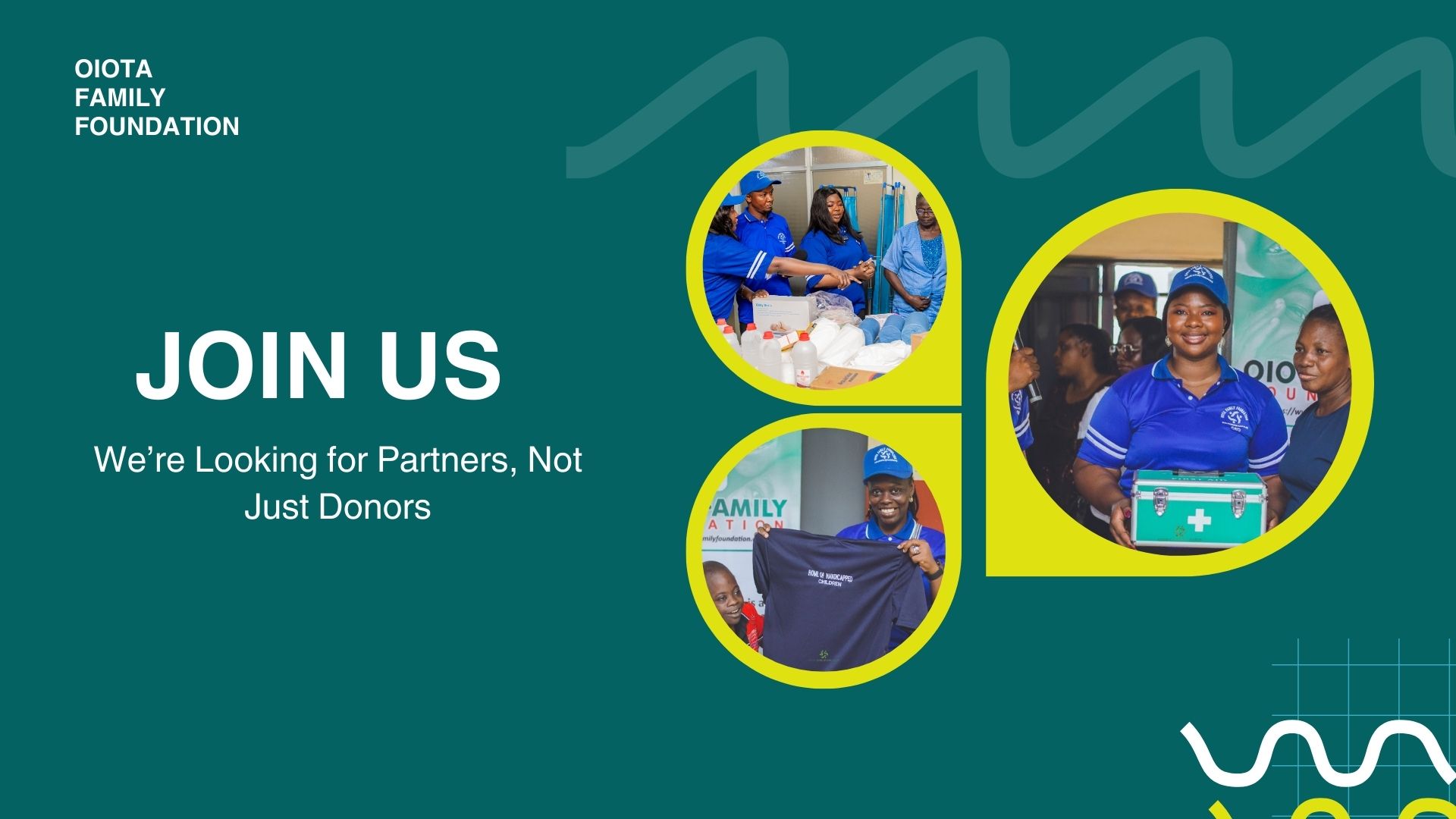
The OIOTA Family Foundation does not want your check. We want your commitment.
There is a difference between writing a check and making change. One takes five minutes. The other takes planning, collaboration, and shared responsibility.
We have spent years running community development projects across Nigeria and the United States. We have provided medical care in Benin City. We have supported children with disabilities in Ibadan. We have fed homeless populations in downtown communities. Every project taught us the same lesson: money alone does not create lasting change.
Traditional donors send funds and walk away. They measure success by the amount given, not the impact created. This approach leaves nonprofits isolated, under-resourced in strategy, and disconnected from the people who fund them.
Partners operate differently. They bring expertise. They offer networks. They participate in planning and execution. They stay involved through challenges and celebrate wins together.
The OIOTA Family Foundation seeks partners, not donors. We need organizations and individuals who want to co-create solutions for underserved communities. We need people who understand that transformation requires more than money. It requires time, knowledge, and genuine investment in the communities we serve.
This is not a fundraising appeal. This is an invitation to build something meaningful together.
The Problem with Traditional Donor Relationships
Most nonprofit funding follows a predictable pattern. A donor identifies a cause. They write a check. They receive a thank-you letter. The relationship ends there.
This transactional model creates several problems for organizations doing real community work.
First, it treats complex social issues like simple purchases. A donor gives $10,000 and expects a neat outcome report. But community development does not work in straight lines. The medical outreach we conducted in Benin City in January 2026 required months of relationship building with Azuwa Hospital, Nigerian Women’s Association, and Salvage Psychiatry. No single check could have predicted or solved the coordination challenges we faced.
Second, traditional donors rarely offer strategic input. They provide funds but not guidance. When we expanded our support to the Home for Handicapped Children in Ibadan, we needed more than money. We needed expertise in disability services. We needed connections to medical suppliers. We needed people who understood the local context and could help us avoid costly mistakes.
Third, accountability flows in only one direction. Nonprofits report to donors. Donors do not share responsibility for outcomes. This creates an imbalanced relationship where the organization carries all the risk and pressure while the donor remains comfortably distant.
Fourth, donor relationships often end abruptly. Priorities shift. Economic conditions change. A project loses funding mid-cycle, leaving communities and organizations scrambling. We have seen this happen to partner organizations across Nigeria. The instability makes long-term planning nearly impossible.
The check-writer model assumes that nonprofit leaders need money but not partnership. This assumption is false. We need financial resources. But we also need strategic thinking, operational support, and committed relationships that extend beyond a single transaction.
When you treat funding as a transaction, you get transactional results. When you build true partnerships, you create sustainable change.
What Makes a Partner Different from a Donor
A donor gives money. A partner invests in outcomes.
The distinction matters because it shapes how we work together and what we accomplish.
Donors operate from a distance. They select causes based on personal interest or tax strategy. They send funds through formal channels. They expect periodic reports. Their involvement ends when the check clears.
Partners engage directly. They ask questions about strategy. They offer expertise from their own fields. They connect us with their networks. They participate in solving problems as they arise.
Here are the characteristics that define true partners:
Shared ownership of goals. Partners help shape project objectives from the start. When we planned the Benin City Free Medical Outreach, our partners at Azuwa Hospital did not just provide space. They helped us identify the most pressing health needs in the community. They advised on which services would have the greatest impact. They co-designed the entire program.
Active involvement in execution. Partners show up. They attend planning meetings. They contribute skills and resources beyond money. During our outreach programs at the Ibadan School for the Deaf, partners brought specialized knowledge about hearing-impaired education that we lacked internally. Their involvement made the program far more effective than it would have been with funding alone.
Mutual accountability. Partners accept responsibility for both successes and failures. They do not blame the nonprofit when things go wrong. They work together to find solutions. This shared accountability creates stronger, more resilient programs.
Long-term commitment. Partners think in years, not quarters. They understand that community development takes time. Our ongoing support for disability services in Ibadan reflects this mindset. Real change requires sustained effort and patient capital.
Strategic contribution. Partners bring more than money to the table. They offer market insights, operational expertise, technology resources, or professional networks. These contributions often prove more valuable than financial support alone.
Transparent communication. Partners expect regular updates. They want honest conversations about challenges. They appreciate being included in decision-making processes. This transparency builds trust and strengthens the relationship over time.
The OIOTA Family Foundation runs lean. We have limited staff. Nearly 100% of our expenses go directly to charitable work. This efficiency is our strength, but it also means we need partners who bring capacity we cannot build internally. We need organizations with deep expertise in healthcare, education, and community development who can amplify our impact.
A donor writes a check and walks away. A partner rolls up their sleeves and gets to work alongside us.
Section 4: Why OIOTA Family Foundation Seeks Partners
The OIOTA Family Foundation focuses on community development and humanitarian aid. Our work spans two continents. We serve underserved populations in Nigeria and the United States.
Our mission requires more than money. It requires specialized knowledge, local connections, and sustained engagement. No single organization possesses all the resources needed to address complex social challenges.
We seek partners because our work demands collaboration.
Our healthcare outreaches in Nigeria require medical expertise we do not hold internally. The Benin City Free Medical Outreach in January 2026 succeeded because partners brought clinical skills, pharmaceutical access, and community trust. We provided coordination and funding. Partners provided the medical capacity that made the outreach possible. Hundreds of families received health screenings, medications, and dental care. This outcome required partnership, not just donation.
Our support for persons with disabilities needs specialized knowledge. The Home for Handicapped Children in Ibadan serves children with complex physical and developmental needs. We provide financial support. But these children need more than money. They need therapeutic equipment, trained caregivers, and educational resources designed for their specific challenges. Partners who understand disability services help us direct resources where they create the most impact.
Our education programs benefit from pedagogical expertise. The Ibadan School for the Deaf requires materials and methods tailored to hearing-impaired students. Standard educational approaches do not work. We need partners who understand deaf education, sign language instruction, and assistive technology. Their knowledge ensures our support actually helps students learn.
Our food security initiatives need logistics support. The Downtown Homeless Food Distribution program feeds underserved populations regularly. This work requires supply chain management, volunteer coordination, and community relationships. Partners who bring operational expertise help us feed more people more efficiently.
Our cultural preservation efforts require community connections. We support the Bini Club of Southern California to preserve Edo culture and serve the Nigerian diaspora. This work demands cultural knowledge and community networks we do not possess. Partners embedded in these communities guide our efforts and ensure our support aligns with actual needs.
We operate as a small, family-run foundation. We have no large staff. We have no bureaucratic overhead. This structure keeps our costs low and our impact high. But it also means we depend on partnerships to scale our work.
We cannot employ full-time medical professionals. We cannot hire education specialists for every school we support. We cannot maintain permanent operations in every Nigerian community we serve. Partners fill these gaps. They bring capacity we cannot build internally.
Our current projects need immediate partnership. We are expanding medical outreaches across Edo State. We are increasing support for disability services in Ibadan. We are developing new food security programs in both Nigeria and the United States. Each initiative requires partners with relevant expertise.
We seek organizations that share our commitment to community development. We seek individuals who want active involvement in creating change. We seek partners who measure success by impact, not by the size of their contribution.
The OIOTA Family Foundation punches above its weight because we collaborate effectively. Our lean structure and partnership approach allow us to direct maximum resources to communities while accessing expertise we could never afford to employ directly.
We need partners now. Communities are waiting. Opportunities exist. The only missing piece is committed collaborators who want to build something lasting together.
What Partnership Looks Like in Practice
Partnership is not abstract. It involves specific actions and shared responsibilities.
Here is what working together actually means at the OIOTA Family Foundation.
Strategy development happens collaboratively. Partners join planning sessions from the beginning. Before we launch a new outreach, we convene stakeholders to identify needs, assess resources, and design interventions. When we planned the Benin City Free Medical Outreach, we did not dictate terms to Azuwa Hospital, Nigerian Women’s Association, and Salvage Psychiatry. We sat together. We mapped community health gaps. We allocated responsibilities based on each partner’s strengths. The hospital provided medical staff and facilities. The women’s association mobilized community participation. Salvage Psychiatry contributed mental health services. We coordinated logistics and provided funding. Everyone contributed to strategy. Everyone owned the outcome.
Execution involves multiple parties. Partners do not fund and disappear. They participate in implementation. During the Benin City outreach, partners staffed medical stations. They distributed medications. They registered families. They handled patient flow. Our role was coordination, not control. This distributed execution model means no single organization carries the entire burden. It also means partners see firsthand how their contributions create impact.
Decision-making authority is shared. When challenges arise during a project, partners help solve them. If medication supplies run low, we problem-solve together. If community turnout is lower than expected, we adjust outreach strategies as a team. Partners have input because they have responsibility. This collaborative approach produces better decisions than any single organization could make alone.
Communication flows constantly. Partners receive regular updates between major projects. We share successes and setbacks. We discussed what worked and what did not. After each outreach, we conduct debrief sessions where all partners evaluate performance and identify improvements. This feedback loop strengthens future collaborations.
Resource contribution varies by partner. Some organizations provide funding. Others contribute expertise, equipment, or volunteer labor. When we support the Home for Handicapped Children in Ibadan, different partners bring different assets. One partner might supply therapeutic equipment. Another might provide staff training. We provide operational funding and coordination. The combination of diverse resources creates comprehensive support that no single contributor could provide.
Impact measurement is transparent. Partners see exactly where resources go and what results they produce. We track specific outcomes. At the Benin City outreach, we documented the number of families served, types of medications distributed, and health screenings conducted. Partners receive detailed reports showing how their contributions translated into community benefit. This transparency builds trust and demonstrates accountability.
Recognition is shared publicly. We acknowledge partners in all communications about our work. When we report on the success of the Ibadan School for the Deaf programs, we name the partners who made that work possible. Their brands and reputations benefit from association with successful community development. This mutual benefit strengthens long-term relationships.
Learning happens together. Every project teaches lessons. We capture these insights and share them across our partnership network. When we discover an effective approach to medication distribution, we document it and share it with partners working on similar challenges. This knowledge sharing multiplies the impact of every project.
Flexibility is expected. The community needs change. External conditions shift. Partners understand that rigid plans often fail in dynamic environments. We adjust strategies together as circumstances require. This adaptive approach keeps programs relevant and effective.
The OIOTA Family Foundation serves as coordinator and catalyst. We identify opportunities, convene partners, and ensure projects stay on track. But we do not control every aspect. Partners bring their own expertise and execute within their areas of strength. This distributed leadership model leverages the full capacity of everyone involved.
Partnership means working side by side. It means sharing both the work and the credit. It means staying engaged through challenges and celebrating wins together.
The Benefits of Being a Partner
Partnership with the OIOTA Family Foundation offers tangible advantages beyond the satisfaction of charitable giving.
Direct involvement in community transformation. Partners see their contributions create real change. You do not wonder whether your support made a difference. You participate in the work and witness the impact firsthand. When you help plan a medical outreach in Benin City, you see families receive care they could not otherwise afford. When you support education programs at the Ibadan School for the Deaf, you watch students gain skills that change their futures. This direct connection to outcomes provides fulfillment that distant donations never deliver.
Complete transparency about resource allocation. Partners know exactly where every dollar goes. We operate with nearly 100% of expenses directed to charitable work. Our small, family-run structure eliminates bureaucratic waste. You receive detailed financial reports and program updates. You attend planning meetings where budgets are discussed openly. This transparency ensures your resources achieve maximum impact.
Access to proven community relationships. We have established trust in the communities we serve. Our ongoing work in Edo State and Ibadan gives us credibility and connections that take years to build. Partners benefit from these relationships immediately. You do not need to spend years building community trust. You step into existing networks and begin creating impact from day one.
Collaboration with other committed organizations. Our partnership network includes hospitals, community associations, educational institutions, and cultural groups. When you partner with us, you gain connections to these organizations. These relationships often lead to additional collaborations beyond our joint projects. Partners expand their own networks while advancing shared goals.
Recognition for your contribution. We acknowledge partners publicly in all communications about our work. Your organization or name appears in impact reports, social media updates, and community announcements. This recognition associates your brand with successful humanitarian work in Nigeria and the United States. The reputational benefit extends your influence beyond your direct contribution.
Measurable impact data. We track specific outcomes for every project. You receive concrete numbers showing lives touched, services delivered, and communities strengthened. At the Benin City Free Medical Outreach, we documented exact figures for health screenings, medication distributions, and families served. Partners get data they need to demonstrate their own impact to stakeholders, boards, or donors.
Influence over project direction. Partners help shape our work. Your expertise and insights inform our strategies. If you bring specialized knowledge in healthcare, education, or community development, that knowledge influences how we design and execute programs. You are not a passive funder. You are an active contributor whose input shapes outcomes.
Long-term relationship building. Partnership creates ongoing connections, not one-time transactions. We work together across multiple projects over years. These sustained relationships develop into genuine collaborations where partners understand each other’s strengths and work together more effectively over time. The relationships often become personally meaningful beyond professional collaboration.
Learning opportunities. Partners gain insights into community development work across two continents. You learn what works in Nigerian communities. You understand challenges facing diaspora populations. You gain perspective on effective nonprofit operations. This knowledge enriches your own work and expands your understanding of global development issues.
Leverage your resources. Your contribution combines with others to create impact greater than any single organization could achieve alone. The partnership model multiplies the effectiveness of every dollar and every hour invested. When multiple partners bring complementary resources to a project, the total impact exceeds the sum of individual contributions.
The OIOTA Family Foundation offers partners something rare in nonprofit work. We offer genuine collaboration with lean operations, proven community relationships, and measurable impact. We operate efficiently. We work transparently. We achieve results.
Partners do not just fund our work. They become part of our work. They share in our successes. They help us navigate challenges. They build something meaningful that extends beyond any single contribution.
How to Become a Partner
The OIOTA Family Foundation welcomes organizations and individuals ready to commit to collaborative community development.
Partnership begins with alignment. We look for potential partners who share our values and complement our capabilities. You do not need to work in every area we serve. You need expertise or resources in at least one domain where we operate: healthcare, education, disability services, food security, or cultural preservation.
We evaluate potential partners on specific criteria. Commitment to community-centered work matters most. We need partners who prioritize community needs over organizational visibility. We look for organizations with relevant expertise that fills gaps in our capacity. We value partners who bring operational capabilities, not just funding. We seek collaborators who understand that meaningful change takes time and sustained effort.
The partnership process follows clear steps.
First, contact us through our website at www.OIOTAfamilyfoundation.org. Express your interest in partnership. Describe your organization’s mission, expertise, and what you hope to accomplish through collaboration. Be specific about the resources or capabilities you bring. Tell us which of our focus areas interests you most.
Second, we schedule an initial conversation. This discussion explores potential fit. We share details about our current projects and future plans. You describe your organization’s strengths and partnership goals. We assess whether our missions align and whether collaboration makes sense for both parties. This conversation is exploratory, not binding.
Third, we identify a specific collaboration opportunity. Partnership works best when focused on concrete projects. We might explore joint work on an upcoming medical outreach in Nigeria. We might discuss collaboration on food distribution programs. We might plan combined efforts supporting disability services in Ibadan. The specific project becomes our testing ground for partnership.
Fourth, we develop a partnership agreement. This document outlines roles, responsibilities, and expectations. It specifies what each partner contributes and what outcomes we pursue together. It establishes communication protocols and decision-making processes. The agreement creates clarity that prevents misunderstandings later.
Fifth, we execute the project together. Partnership moves from planning to action. We work side by side through implementation. We communicate regularly. We solve problems collaboratively. We track progress and adjust strategies as needed.
Sixth, we evaluate results and plan next steps. After completing a project, we assess what worked and what did not. We review impact data. We gather feedback from communities served. We decide whether to continue the partnership and what future collaborations might look like.
Partnership types vary based on what you bring. Financial partners provide funding for specific projects or ongoing operations. These partners often want involvement in strategic decisions about resource allocation. Operational partners contribute staff time, expertise, or equipment. Healthcare organizations might provide medical professionals for outreach programs. Educational institutions might supply teaching materials or training. Technical partners offer specialized knowledge in areas like logistics, communications, or program evaluation. Network partners connect us with additional resources, communities, or collaborators.
We welcome partners at different scales. Large organizations bring substantial resources and capabilities. Small organizations often provide specialized expertise or local connections. Individual professionals contribute skills and networks. All partnership levels create value when commitment and capability align with our needs.
The OIOTA Family Foundation needs partners now. Our expansion plans for medical outreaches across Edo State require healthcare partners. Our growing disability support programs need organizations with therapeutic expertise. Our food security initiatives need logistics and volunteer coordination support. Our cultural preservation work needs community organizations with deep diaspora connections.
We are not looking for passive supporters. We are looking for active collaborators who want to roll up their sleeves and create lasting change in underserved communities.
Contact us at www.OIOTAfamilyfoundation.org. Tell us about your organization. Share your vision for partnership. Let us explore how we might work together to strengthen communities in Nigeria and the United States.
Conclusion
The OIOTA Family Foundation does not need more donors. We need more partners.
Donors write checks. Partners create change. The difference determines whether communities receive temporary relief or lasting transformation.
We have proven that lean operations and strong partnerships produce outsized impact. Our medical outreaches serve hundreds of families in Benin City. Our disability programs support vulnerable children in Ibadan. Our food distribution feeds homeless populations. Our cultural work preserves heritage and strengthens diaspora communities. We achieve these results because we collaborate effectively with committed partners who bring more than money to the table.
The check-writer model is broken. It treats complex social problems like simple transactions. It isolates nonprofits from the expertise and networks they need. It creates dependency rather than capacity. It measures inputs instead of outcomes.
The partner model works. It brings diverse resources and capabilities together. It shares responsibility and accountability. It builds relationships that last beyond single projects. It creates sustainable change because multiple stakeholders invest in success.
We operate in communities that need urgent support. Children with disabilities in Ibadan wait for services. Families in rural Edo State lack access to basic healthcare. Homeless populations in American cities go hungry. The Nigerian diaspora needs cultural anchors. These needs will not wait for perfect conditions or complete funding. They require action now.
You have a choice. You write a check and move on. You become a partner and stay engaged. One option takes five minutes. The other takes commitment. One creates a transaction. The other builds something lasting.
The OIOTA Family Foundation invites you to choose partnership. Bring your expertise. Share your networks. Contribute your resources. Work alongside us to strengthen communities that deserve better than they currently receive.
We have community relationships. We have operational experience. We have the track record of efficient, effective work. What we need is partners who share our commitment to community-centered development and who want active involvement in creating change.
Visit www.OIOTAfamilyfoundation.org. Learn more about our work. Contact us about partnership opportunities. Let us build something meaningful together.
Communities are waiting. The work continues. Partners make the difference between what we hope to accomplish and what we actually achieve.
Join us. Not as a donor. As a partner.
Leave a Reply