On Friday, the Benin City team of the OIOTA Family Foundation visited Central Hospital on Golf Course Road to check on the medical equipment and consumables we donated during our outreach in September last year. This post explains what we set out to do, what we found, and why follow-up visits matter for anyone who gives to a public health facility in Nigeria. If you are a donor, a volunteer, or a member of another foundation planning a similar donation, the experience below may help you plan your own follow-up.
Why We Visited Central Hospital
Donating equipment is the first step. Knowing that it reaches patients and stays in use is the step that gives a donation its value. Our outreach last year was a major one, with medical equipment and consumables handed over to the hospital. This visit was planned as an accountability check.
Before going, the team set five goals:
- Take photos and videos for documentation and media purposes
- Check the status of some of the equipment we donated
- Check on the wellbeing of some of the patients
- Meet with the Chief Medical Director (CMD) to discuss how the donated equipment is being used
- Request an appreciation letter from the CMD’s office
What Happened When We Arrived
We went straight to the CMD’s office at Central Hospital and found it occupied by patients. After asking questions, we learned that the office had been moved to the Edo Hospitals Management Agency (EHMA). The agency oversees public secondary healthcare facilities in Edo State, including Central Hospital, Benin. The building on Golf Course Road now also houses wards such as the newborn ward, pediatric ward, and gynaecology ward.
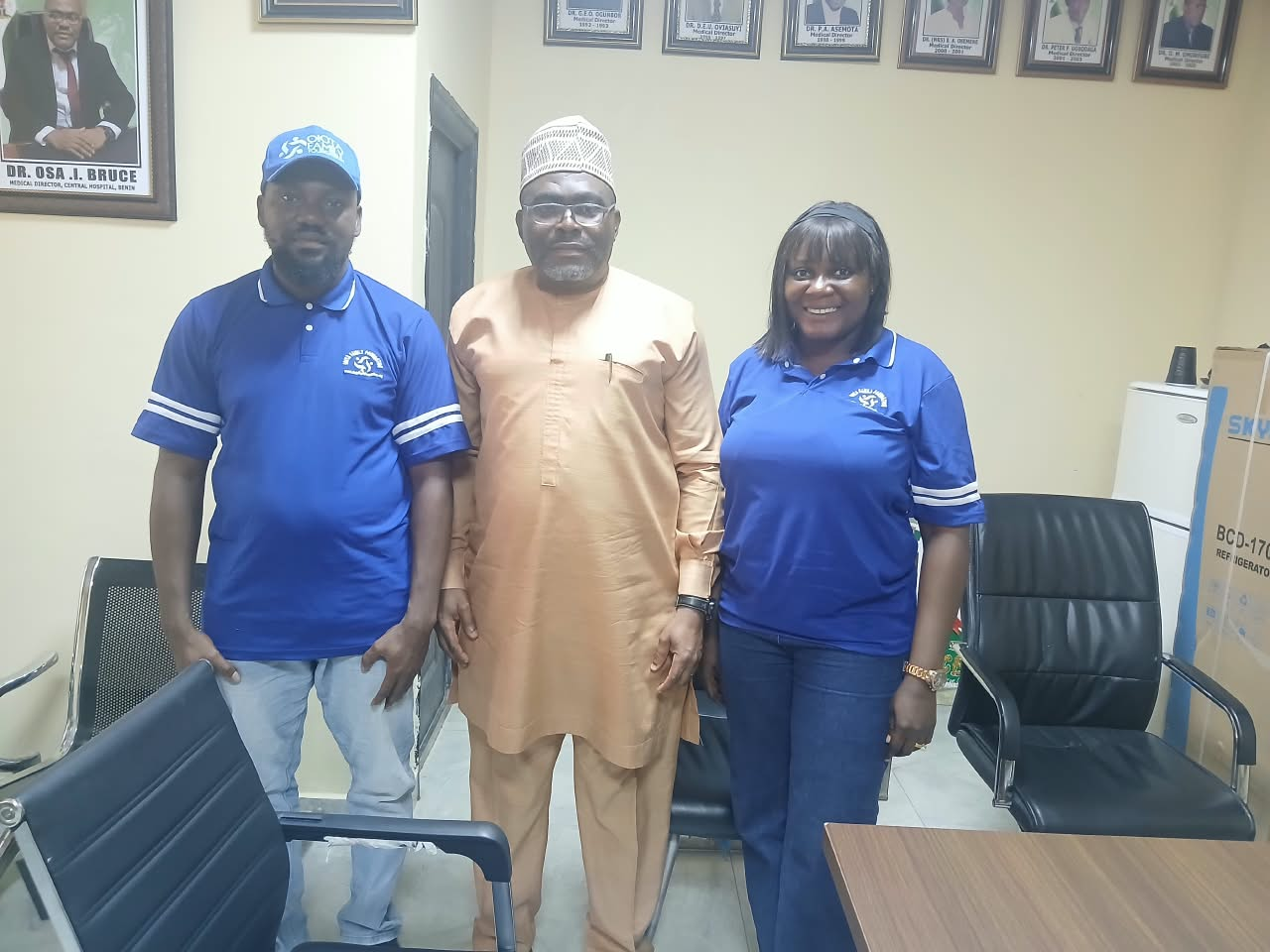
We then travelled to the agency’s office along Sapele Road. Outside the building, we met the Managing Director, Dr. Bruce Osa. He recognised our foundation t-shirt immediately and welcomed us warmly. He took us to his office, and after a short wait while he finished other work, he received us.
A Thank You Before We Said a Word
Before we began to explain our visit, Dr. Osa thanked the OIOTA Family Foundation for the donation. He told us the equipment has helped the hospital treat patients. We then spoke at length about the state of the health sector in Edo State and in Nigeria as a whole.
When we explained the purpose of our visit, he called the officer responsible for keeping stock records in the medical facility, so we could trace the items.
Tracing the Donation Through the Records
The stock officer called the people in charge of several wards. Some of them did not recall a donation from the foundation. She explained that she is the main storekeeper and was off duty on the day of our outreach, so she had no personal memory of it. She raised the possibility that the donation might not have been recorded at all.
Dr. Osa instructed her to check her office records going back to September last year. This meant returning to Central Hospital, where her office is located, so we travelled back.
The Records Were There
After searching, she found the OIOTA Family Foundation donation recorded in a file. Every item was listed, including the consumables, along with the wards each item had been sent to. This was reassuring. It showed that the hospital keeps proper records and that our donation was formally accounted for.
For donors, this is a useful lesson. The people on duty may not remember a donation made a year earlier, but a good record keeps the history. It also helps to hand over a written list of donated items at the time of the outreach, so that both sides hold a copy.
Where the Donated Items Are Now
With the records in hand, we returned to the Edo Hospitals Management Agency to check the status of the items in the wards listed. We learned that:
- Some items were sent to the Children’s Hospital, which is in a different location
- Some items were sent to other state government hospitals and, in a few cases, were later returned
- Some items are held within the Edo Hospitals Management Agency
- The folding screens are still in use at the old Central Hospital site, where our outreach took place, in the pediatric section
This shows that donated equipment in a public health system does not always stay in one place. Items are redistributed according to need across the facilities the agency oversees. Following up means tracing where they went and not only checking the original location.
The Wards We Visited
We were permitted to enter several wards:
- General admission ward
- Surgical ward
- Neonatal ward, which cares for premature babies
- Gynaecology ward
- Pediatric ward
We were not permitted to enter the accident and emergency ward. Photography was not allowed in some wards, so the team came away with only a few photos. These restrictions protect patient privacy and are a normal part of hospital visits. We saw some of the donated items actively in use in the wards we entered.
The Appreciation Letter
Before leaving Dr. Osa’s office, we asked for an appreciation letter for the September outreach. He said he believed the letter had already been sent to us. He promised to send it to the foundation and asked us to leave our email address and WhatsApp contact so it could be forwarded. We will follow up with his office if it has not arrived within the next few days.
What We Took Away From the Visit
The visit was eventful and fulfilling. Most of the donated items were well documented and accounted for, and we saw some of them in active use. From the Managing Director to the nurses, everyone we met thanked the foundation and prayed for our work. Their appreciation encourages the team to continue.
Here are practical lessons for any organisation planning a donation to a public hospital:
- Give a written inventory of donated items at handover and keep a signed copy.
- Ask which wards or facilities will receive each item.
- Schedule a follow-up visit several months after the outreach.
- Confirm current office locations before visiting, since administrative offices can move.
- Ask in advance about photography and ward access rules.
- Request any acknowledgement letter at the time of handover, and agree on how it will be delivered.
Frequently Asked Questions
Why should foundations follow up after donating medical equipment?
Follow-up confirms that the equipment reached patients and is being used as intended. It also builds trust with hospital management and gives donors accurate information to share with supporters.
How can a donor confirm that donated items were recorded?
Ask to see the hospital’s stock or store records. A well-kept file lists each item, the date received, and the ward it was issued to, as we found at Central Hospital.
Is it normal for donated equipment to be moved to other hospitals?
In a public system managed by an agency, items can be reassigned to other facilities based on need. This is why it helps to request the distribution list and trace items beyond the first location.
Can visitors take photos inside hospital wards?
Some wards restrict photography to protect patient privacy. Ask for permission at each ward and follow the hospital’s instructions.
How can I support the OIOTA Family Foundation?
You can follow our updates and reach out to the foundation to learn about upcoming outreaches, volunteering, and donations.
Next Steps
The OIOTA Family Foundation is grateful to the management and staff of Central Hospital and the Edo Hospitals Management Agency for receiving the Benin City team. We will continue to follow up on our outreaches so that every donation serves the patients it was meant for. If you would like to partner with us or volunteer on a future outreach, please contact the foundation through our official channels.
A few notes for your editing: I left out any contact details and links because none were supplied, so add the foundation’s website, email, or social handles in the final paragraph. The report uses both “Dr. Bruce Osa” and “Dr. Ben” for the Managing Director, and I used “Dr. Osa” throughout, so please confirm the correct name. The report also lists the surgical ward as both visited and not allowed, so I listed it as visited. Please check that and correct it if needed. Finally, add your photos under the relevant headings, and update the paragraph on the appreciation letter once it arrives.